Saturday, 15 September 2012

TOXICOLOGY: The Science of Poisons


“The Science of Poisons” defines what toxicology is but the more appropriate definition is that toxicology is the study of the adverse effects of chemicals on living organisms. It is the study of symptoms, mechanisms, treatments and detection of poisoning, especially the poisoning of people.


These adverse effects may occur in many forms, ranging from immediate death to subtle changes not realized until months or years later. They may occur at various levels within the body, such as an organ, a type of cell, or a specific biochemical. Knowledge of how toxic agents damage the body has progressed along with medical knowledge. It is now known that various observable changes in anatomy or body functions actually result from previously unrecognized changes in specific biochemicals in the body.


A photo showing different drugs.
Photo credit:
http://www.aperianlabsolutions.com/ToxLab/DrugTesting.aspx
Toxicity is complex with many influencing factors; dosage is the most important. Xenobiotics cause many types of toxicity by a variety of mechanisms. Some chemicals are themselves toxic. Others must be metabolized (chemically changed within the body) before they cause toxicity.

Xenobiotic is a term used to describe foreign substances taken into the body. The word is taken from the Greek xeno, meaning "foreigner". Xenobiotics do not just produce toxic effects, but can also produce beneficial ones as in the case of pharmaceuticals. Whereas high doses of certain toxins in the body can lead to death, smaller doses may be harmless or even beneficial. This is known as the dose-response relationship, a major concept in toxicology.

Toxicity can result from adverse cellular, biochemical, or macromolecular changes like for example:


  • cell  replacement (fibrosis)
  • damage to an enzyme system
  • disruption of protein synthesis
  • production of reactive chemicals in cells


Factors that can affect toxicity of a substance:


  • form and innate chemical activity
  • dosage
  • exposure route 
  • species
  • age
  • sex
  • ability to observed 
  • metabolism 
  • excretion 
  • distribution within the body 
  • presence of other chemicals 

BRANCHES OF TOXICOLOGY
  • Risk assessment is a branch of toxicology which attempts to determine, probabilistically, outside the laboratory, the likelihood of an adverse effect based on a particular exposure scenario. This is not experimental activity, involves much more uncertainty about its findings and is as much art as science. It is conducted quantitatively, relying on mathematics and computer modeling, or qualitatively, relying more on experience and similar scenarios that have been previously looked at.
  • Regulatory toxicology relies on risk assessment and experimental data to determine the risk and benefits, or the costs and benefits of exposure to certain chemicals, to determine whether such chemical will be allowed in the public sphere and to what extent its use and exposure will be regulated. This field of toxicology probably has the greatest effect on our daily lives of all the different fields of toxicology.
  • Clinical toxicology involves the application of toxicological principles within a diagnostic setting, usually to determine whether a presenting adverse effect or disease or injury is due to some type of chemical exposure. This area of toxicology is typically practiced by a physician, nurse or other clinician, often times in consultation with the experimental toxicologist, who is in a position to better explain certain published experimental findings and whether they would be applicable to the case at hand.

  • Forensic toxicology focuses on medical-legal aspects  of chemical exposure and toxic injury. Evaluation of analytical chemistry techniques and measurements, and testimony of conclusions and opinions in courts of law encompass the activity of this specialized field of toxicology.


  • Environmental Toxicology is also known as entox, is a multidisciplinary field of science concerned with the study of the harmful effects of various chemical, biological and physical agents on living organisms.



For better understanding of Toxicology, here are some of the terminologies to be known:
  • Toxic agent is anything that can produce an adverse biological effect. It may be chemical, physical, or biological in form. 
  • Toxic substance is simply a material which has toxic properties. It may be a discrete toxic chemical or a mixture of toxic chemicals. 
  • Systemic toxin is one that affects the entire body or many organs rather than a specific site. 
  • Benzene is a specific organ toxin in that it is primarily toxic to the blood-forming tissues.
  • Lead is also a specific organ toxin; however, it has three target organs (central nervous system, kidney, and hematopoietic system).
  • Germ cells are those cells that are involved in the reproductive process and can give rise to a new organism. They have only a single set of chromosomes peculiar to a specific sex.
  • Somatic cells are all body cells except the reproductive germ cells. They have two sets (or pairs) of chromosomes.
REFERENCES:
http://www.themoldsource.com/experts/Toxicology.html
http://www.wisegeek.com/what-is-toxicology.htm
http://www.toxicologysource.com/whatistoxicology.html

EDUBLOGGING: Even students can be a teacher.


Internet connection at home, internet connection at your neighborhood, wifi zone at shopping malls, and when you go to restaurants, or even inside the bus, wifi is usually free. I can't never think of any particular place nowadays which internet connection wasn't being important. People are very fond of using different gadgets to be updated at all times by means of surfing the internet, this fact is one of the major consideration why EDUBLOGGING would be in. 


“In learning you will teach, and in teaching you will learn.” --- Phil Collins


I already knew what blog is, in fact I already experienced to make one, but edublogging is very different. Edublogging is an easy, advanced and a very interesting way of teaching people through blogs. At first, you would be a little bit nervous because you want your blog to be a great one, but eventually you will find yourself enjoying what you are doing and when you enjoy doing something the result would be magnificent. 

Overwhelmed, trusted, happy, and fulfilled are the four words which can describe my feelings toward edublogging. It was really a privileged to do something which enhances me myself as a student in researching, analyzing and understanding a topic. Also by edublogging, the teacher part inside of me is revealed. 

I'm studying to learn and I'm studying to teach. Being a student doesn't limit yourself to teach others, to share and impart whatever knowledge that you have. Through edublogging, we can really make a difference, it is important that we know that it is always better to give and share and ofcourse to inspire others too. 

I hope that through this blog there would be a lot more that would engage in edublogging. Learning doesn't only depend on lecture notes, boards, chalks, books etc., learning is everywhere, learning is within us, and the art of teaching would be always inside of us. 

Tuesday, 15 May 2012

Introduction to Endocrinology

A picture showing the different glands of the Endocrine System. 


As a human being, there are a lot of things that undergo in our body, and as we grow up we also became more conscious about everything, about how does it works, for what reason does it have to function, and a lot more. The regulation of our body's growth, sexual development and function, metabolism and a lot more are just some of the processes that takes place because of a one important substance, the "hormone"

Hormones serve as the chemical messenger, as a messenger, they transfer information and details from one set of cells to another to coordinate the functions of different parts of the body, it regulates the activity of cells or organs. 


Hormones are produced and are secreted by the different glands of our endocrine system, that is why our endocrine system is very important and we have to know a lot about this system for us to be able to appreciate its real importance.


Hypothalamus, parathyroid, adrenal, pituitary, thyroid, pineal body, and the reproductive organs (ovaries and testes) are the major glands of the endocrine system. Pancreas is also included and it is associated in hormone production as well as in digestion. 

The following will give you some information about the different major glands of the endocrine system.

1. HYPOTHALAMUS

Hypothalamus

The hypothalamus is located in the lower central part of the brain. The hypothalamus is responsible for certain metabolic processes and other activities of the Autonomic Nervous System. It synthesizes and secretes neurohormones, and these in turn stimulate the secretion of pituitary hormones. 
  • Corticotropic Releasing Hormone (CRH) releases Adrenocorticotropic Hormone (ACTH)
  • Thyrothropine Releasing Hormone (TRH)- releases Thyroid Stimulating Hormone (TSH)
  • Gonadotropin Releasing Hormone (GnRH)- releases Leutinizing Hormone (LH) and Follicle Stimulating Hormone (FSH)
  • Somatostatin- releases Growth Hormone (GH)

2. PITUITARY GLAND


The pituitary is referred to as the master gland as it controls hormone functions such as our temperature, thyroid activity, growth, urine production, testosterone production in males and ovulation and estrogen production in females. Two distinct parts of the pituitary gland are the anterior and the posterior lobes, each of these two releases different hormones which affect bone growth and regulate activity in other glands. 

Anterior lobe hormones: 
  • Growth Hormone (GH)
  • Leutinizing Hormone (LH)
  • Follicle Stimulating Hormone (FSH)
  • Thyroid Stimulating Hormone (TSH)
  • Prolactin (PRL)
  • Adrenocorticotropic Hormone- (ACTH)
Posterior lobe hormones:
  • Antidiuretic Hormone (ADH) or Vasopressin
  • Oxytocin

3.THYROID GLAND

Photo credit: 
The thyroid gland produces thyroid hormones that are responsible for the regulation of the body's metabolism; it is also associated in bone growth and development of the brain and nervous system of a child. Thyroid hormones are also responsible in the maintenance of normal blood pressure, digestion, muscle tone, heart rate, and reproductive functions. 


Thyroid hormones: 
  • T3- Triidothyronine 
  • T4- Tetraiodothyronine or Thyroxine

4. PARATHYROID GLAND


The parathyroid glands are four small oval bodies located on either side or on the dorsal aspect of the thyroid gland, they are the one who releases parathyroid hormone (parathormone) that controls the level of calcium in the blood. 

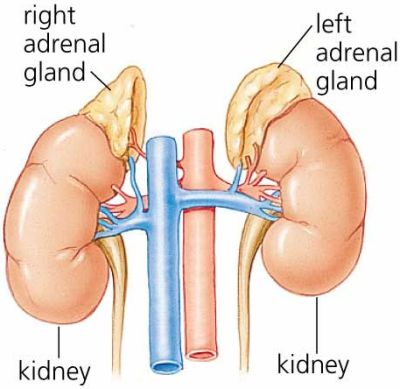
5. ADRENAL GLAND


The adrenal glands are a pair of gland that secretes hormone directly into the bloodstream, they take instruction from the pituitary gland and have important effects on physical characteristics, growth and on development. The outer part of the adrenal gland is termed as the adrenal cortex, it produces corticosteroids that regulate the body's metabolism, the balance of salt and water in a person's body, sexual function and the immune system. The inner part of the adrenal gland is termed as the adrenal medulla, it produces catecholamines and epinephrine

6. PINEAL GLAND


The pineal gland can be found in the middle of the brain, this secretes melatonin which helps in the regulation of the wake-sleep cycle of the body.

7. OVARIES

Photo credit: 
http://www.riversideonline.com/health_reference/Test-Procedure/MY00554.cfm?RenderForPrint=1


The ovaries are a pair of oval or almond-shaped glands which lie on either side of the uterus and just below the opening to the fallopian tubes. The ovaries is the one that produces female sex hormones, they are called estrogen and progesterone. The ovaries also store ova. The female, unlike the male, does not manufacture the sex cells.

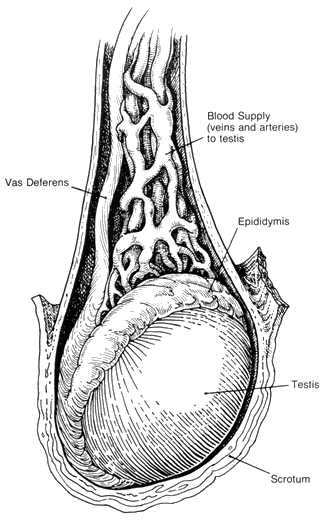
8. TESTES

Photo credit: http://www.cancer-concerns.com/TEST/test1.htm

Testes are located in the scrotum, it secretes androgen, the most important of which is testosterone. This hormones affects a lot of male characteristics as well as sperm production. 

9. PANCREAS
Photo credit: http://biologiafotosdibujosimagenes.blogspot.com/2011/06/dibujos-del-pancreas-y-sus-partes.html


The pancreas has two functions, the hormonal and digestive functions. The exocrine pancreas secretes digestive enzymes while the endocrine pancreas on the other hand secretes hormones termed as insulin and glucagon. The said hormones regulate the glucose level (sugar) in the blood of an individual.

For more understanding about this topic, here is a short video about the Endocrine system. Watch, learn, have fun and see you on my next blog as I discuss more about the Endocrine System :)