

A picture showing the different glands of the Endocrine System.
Photo credit : http://e.hormone.tulane.edu/learning/endocrine-system.html
As a human being, there are a lot of things that undergo in our body, and as we grow up we also became more conscious about everything, about how does it works, for what reason does it have to function, and a lot more. The regulation of our body's growth, sexual development and function, metabolism and a lot more are just some of the processes that takes place because of a one important substance, the "hormone".
Hormones serve as the chemical messenger, as a messenger, they transfer information and details from one set of cells to another to coordinate the functions of different parts of the body, it regulates the activity of cells or organs.
Hormones are produced and are secreted by the different glands of our endocrine system, that is why our endocrine system is very important and we have to know a lot about this system for us to be able to appreciate its real importance.
Hypothalamus, parathyroid, adrenal, pituitary, thyroid, pineal body, and the reproductive organs (ovaries and testes) are the major glands of the endocrine system. Pancreas is also included and it is associated in hormone production as well as in digestion.
The following will give you some information about the different major glands of the endocrine system.
1. HYPOTHALAMUS

Photo credit: http://genericlook.com/anatomy/Hypothalamus/
- Corticotropic Releasing Hormone (CRH) - releases Adrenocorticotropic Hormone (ACTH)
- Thyrothropine Releasing Hormone (TRH)- releases Thyroid Stimulating Hormone (TSH)
- Gonadotropin Releasing Hormone (GnRH)- releases Leutinizing Hormone (LH) and Follicle Stimulating Hormone (FSH)
- Somatostatin- releases Growth Hormone (GH)
2. PITUITARY GLAND

The pituitary is referred to as the master gland as it controls hormone functions such as our temperature, thyroid activity, growth, urine production, testosterone production in males and ovulation and estrogen production in females. Two distinct parts of the pituitary gland are the anterior and the posterior lobes, each of these two releases different hormones which affect bone growth and regulate activity in other glands.
Anterior lobe hormones:
- Growth Hormone (GH)
- Leutinizing Hormone (LH)
- Follicle Stimulating Hormone (FSH)
- Thyroid Stimulating Hormone (TSH)
- Prolactin (PRL)
- Adrenocorticotropic Hormone- (ACTH)
Posterior lobe hormones:
- Antidiuretic Hormone (ADH) or Vasopressin
- Oxytocin
3.THYROID GLAND

Photo credit:
The thyroid gland produces thyroid hormones that are responsible for the regulation of the body's metabolism; it is also associated in bone growth and development of the brain and nervous system of a child. Thyroid hormones are also responsible in the maintenance of normal blood pressure, digestion, muscle tone, heart rate, and reproductive functions.
Thyroid hormones:
- T3- Triidothyronine
- T4- Tetraiodothyronine or Thyroxine
4. PARATHYROID GLAND

The parathyroid glands are four small oval bodies located on either side or on the dorsal aspect of the thyroid gland, they are the one who releases parathyroid hormone (parathormone) that controls the level of calcium in the blood.
5. ADRENAL GLAND
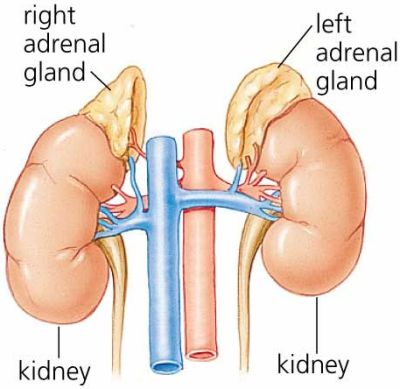
The adrenal glands are a pair of gland that secretes hormone directly into the bloodstream, they take instruction from the pituitary gland and have important effects on physical characteristics, growth and on development. The outer part of the adrenal gland is termed as the adrenal cortex, it produces corticosteroids that regulate the body's metabolism, the balance of salt and water in a person's body, sexual function and the immune system. The inner part of the adrenal gland is termed as the adrenal medulla, it produces catecholamines and epinephrine.
6. PINEAL GLAND

The pineal gland can be found in the middle of the brain, this secretes melatonin which helps in the regulation of the wake-sleep cycle of the body.
7. OVARIES

Photo credit:
http://www.riversideonline.com/health_reference/Test-Procedure/MY00554.cfm?RenderForPrint=1
The ovaries are a pair of oval or almond-shaped glands which lie on either side of the uterus and just below the opening to the fallopian tubes. The ovaries is the one that produces female sex hormones, they are called estrogen and progesterone. The ovaries also store ova. The female, unlike the male, does not manufacture the sex cells.
8. TESTES
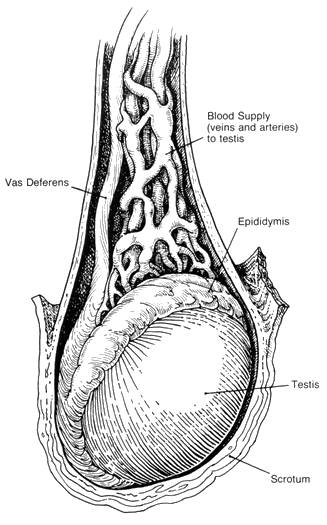
Photo credit: http://www.cancer-concerns.com/TEST/test1.htm
Testes are located in the scrotum, it secretes androgen, the most important of which is testosterone. This hormones affects a lot of male characteristics as well as sperm production.
9. PANCREAS

Photo credit: http://biologiafotosdibujosimagenes.blogspot.com/2011/06/dibujos-del-pancreas-y-sus-partes.html
The pancreas has two functions, the hormonal and digestive functions. The exocrine pancreas secretes digestive enzymes while the endocrine pancreas on the other hand secretes hormones termed as insulin and glucagon. The said hormones regulate the glucose level (sugar) in the blood of an individual.
For more understanding about this topic, here is a short video about the Endocrine system. Watch, learn, have fun and see you on my next blog as I discuss more about the Endocrine System :)
REFERENCES:
- Clinical Chemistry Techniques, Principles, Correlations 6th edition by Michael Bishop, Edward Fody and Larry Schoeff


come see me
ReplyDelete